
Have you ever looked at a water tank, a soda can, or even a roll of paper towels and wondered how much space it actually holds? That curiosity leads straight to one powerful concept in geometry: the Volume of Cylinder Formula.
It might sound technical at first. However, once you understand the logic behind it, everything clicks into place. In fact, the volume of a cylinder formula is one of the simplest and most practical formulas in mathematics. You’ll see it in classrooms, construction sites, engineering projects, and even in everyday life.
In this guide, I’ll walk you through the formula step by step. We’ll explore what it means, why it works, and how to apply it correctly. Moreover, I’ll include clear examples, practical applications, and common mistakes to avoid. By the end, you won’t just memorize the formula — you’ll truly understand it.
What Is a Cylinder?
Before diving into the Volume of Cylinder Formula, let’s quickly understand what a cylinder actually is.
A cylinder is a three-dimensional geometric shape with:
-
Two parallel circular bases
-
A curved surface connecting the bases
-
A constant radius from top to bottom
-
A specific height
Think of objects like:
-
A soda can
-
A pipe
-
A water tank
-
A candle
-
A battery
Each of these represents a right circular cylinder, which is the most common type used in math problems.
Key Parts of a Cylinder
To understand the volume of a cylinder formula, you need to know its main components:
-
Radius (r): The distance from the center of the circular base to its edge
-
Diameter (d): Twice the radius
-
Height (h): The distance between the two circular bases
-
Base area: The area of one circular base
Now that we know the structure, let’s move toward the actual formula.
What Is the Volume of Cylinder Formula?
The Volume of Cylinder Formula is:
V = πr²h
Where:
-
V = Volume
-
π = Pi (approximately 3.1416)
-
r = Radius of the base
-
h = Height of the cylinder
Simple, right?
However, there’s logic behind it. Let’s break it down.
Why Does the Volume of Cylinder Formula Work?
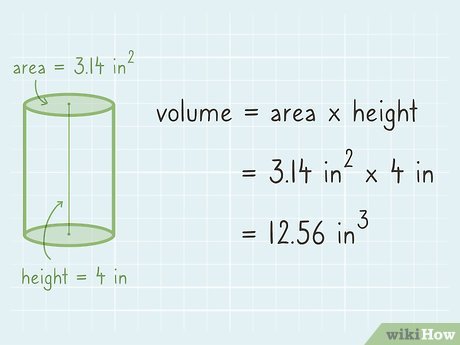
To truly understand the volume of a cylinder formula, imagine stacking circles on top of each other.
A cylinder is basically:
Area of circular base × Height
We already know the formula for the area of a circle:
Area = πr²
So if you multiply that by the height, you get:
Volume = πr² × h
Volume = πr²h
In other words, the volume of a cylinder formula calculates how much space is inside the 3D shape by stretching a circle upward.
It’s beautifully simple when you see it that way.
Step-by-Step: How to Use the Volume of Cylinder Formula
Let’s go through the steps carefully.
Step 1: Identify the Radius
Check whether the problem gives you:
-
Radius directly
-
Diameter (you’ll need to divide by 2)
If diameter is given:
r = d ÷ 2
Step 2: Identify the Height
Make sure the height is perpendicular to the base.
Also, check that all measurements use the same unit (cm, m, inches, etc.). Unit consistency is crucial in geometry.
Step 3: Square the Radius
Compute:
r²
This means multiply the radius by itself.
Step 4: Multiply by π
Use either:
-
π symbol (for exact answers), or
-
3.14 (for approximate answers)
Step 5: Multiply by Height
Finally, multiply the result by h.
And that’s it. You’ve applied the volume of a cylinder formula correctly.
Example 1: Basic Problem
Find the volume of a cylinder with:
Radius = 3 cm
Height = 10 cm
Step 1: Write the formula
V = πr²h
Step 2: Substitute values
V = π × (3)² × 10
Step 3: Square the radius
3² = 9
Step 4: Multiply
V = π × 9 × 10
V = 90π
Step 5: Approximate
V ≈ 90 × 3.14
V ≈ 282.6 cubic cm
Final Answer: 282.6 cm³
See? The volume of cylinder formula works smoothly when you follow the steps.
Example 2: When Diameter Is Given
Diameter = 12 m
Height = 5 m
Step 1: Convert diameter to radius
r = 12 ÷ 2 = 6 m
Step 2: Apply the volume of a cylinder formula
V = πr²h
V = π × 6² × 5
Step 3: Calculate
6² = 36
36 × 5 = 180
V = 180π
Approximate answer:
V ≈ 180 × 3.14
V ≈ 565.2 cubic meters
Always remember: if the problem gives diameter, divide by 2 first.
Units of Volume
The result of the volume of cylinder formula is always in cubic units:
-
cm³
-
m³
-
in³
-
ft³
If measurements are in centimeters, your answer will be in cubic centimeters.
That’s because volume measures three-dimensional space.
Real-Life Applications of the Volume of Cylinder Formula
Now let’s talk practical use. This formula is not just for exams.
1. Water Tanks
Engineers use the volume of cylinder formula to calculate water storage capacity.
2. Oil Drums
Manufacturers measure fuel capacity using cylindrical volume.
3. Construction Pipes
Plumbers calculate pipe capacity using radius and height.
4. Packaging Industry
Companies determine container capacity before production.
5. Chemistry and Physics
Scientists calculate liquid volume in cylindrical beakers.
In short, the volume of a cylinder formula is everywhere.
Common Mistakes Students Make
Even though the formula is simple, errors happen.
Here are common mistakes:
-
Using diameter instead of radius
-
Forgetting to square the radius
-
Mixing units (cm and meters together)
-
Rounding too early
-
Writing square units instead of cubic units
However, once you practice consistently, these errors disappear.
Surface Area vs Volume: Don’t Confuse Them
Many students mix up formulas.
Surface Area Formula:
2πr² + 2πrh
Volume Formula:
πr²h
Notice the difference?
Surface area deals with the outside.
Volume deals with space inside.
That distinction is essential in geometry.
Volume of Hollow Cylinder
What if the cylinder is hollow?
In that case, the formula becomes:
V = πh(R² − r²)
Where:
-
R = Outer radius
-
r = Inner radius
This version of the volume of cylinder formula is often used in engineering and mechanical design.
Quick Formula Summary Table
Concept | Formula
Area of Circle | πr²
Volume of Cylinder | πr²h
Hollow Cylinder Volume | πh(R² − r²)
Keep this table handy for quick revision.
Practice Questions
Try these on your own:
-
Radius = 4 cm, Height = 8 cm
-
Diameter = 14 m, Height = 20 m
-
Radius = 2.5 in, Height = 15 in
Practicing the volume of a cylinder formula multiple times builds confidence quickly.
Why Students Struggle with Volume
Honestly, it’s rarely the formula itself. The real issue is:
-
Weak understanding of basic algebra
-
Confusion between area and volume
-
Fear of word problems
However, when you understand the logic — circle area times height — everything becomes logical.
Math is not about memorization. It’s about understanding structure.
Advanced Tip: Using Calculators Correctly
When using a scientific calculator:
-
Square the radius first
-
Multiply by π
-
Multiply by height
-
Round at the final step
This avoids rounding errors.
Moreover, if your teacher allows exact answers, leave π in symbolic form.
Word Problem Example
A cylindrical water tank has:
Radius = 7 m
Height = 12 m
How much water can it store?
Solution:
V = πr²h
V = π × 7² × 12
7² = 49
49 × 12 = 588
V = 588π
V ≈ 1846.32 m³
That’s a massive amount of water.
This example shows how the volume of cylinder formula applies in real engineering scenarios.
Frequently Asked Questions
Is the Volume of Cylinder Formula Always πr²h?
Yes, for a right circular cylinder.
What If the Cylinder Is Slanted?
For oblique cylinders, the same formula still works as long as height is perpendicular.
Why Do We Square the Radius?
Because the base is a circle, and circle area uses r².
Final Thoughts
The Volume of Cylinder Formula is not just another equation to memorize. It’s a powerful geometric tool that helps us measure real-world space.
When you break it down, it’s simply:
Area of base × height
That’s it.
However, understanding each step makes all the difference. Whether you’re solving math homework, preparing for competitive exams, or working in engineering fields, mastering the volume of a cylinder formula gives you confidence.
So here’s what I suggest:
Practice at least five problems today.
Double-check your units.
Understand the logic behind πr²h.
And if this guide helped you finally understand the concept, share it with someone who struggles with geometry. Learning becomes easier when we grow together.